Beyond Numbers: Cultivating Your Child's Mathematical Mind from Play to Problem-Solving
Math skills are more than memorizing tables. They are a language of logic, patterns, and confidence. This guide helps you nurture a genuine mathematical mindset in your child, transforming daily moments into joyful learning.
For many of us, the word "math" instantly conjures school memories of rigid drills, anxiety before tests, and the relentless pursuit of the one right answer. It’s time to rewrite that story for our children. Mathematical thinking isn't a niche talent; it's a foundational life skill. It's the language of logic, patterns, reasoning, and creative problem-solving. It’s in the symmetry of a rangoli, the estimation in a kitchen, the strategy in a board game, and the budgeting for a family outing.
Our goal isn't to create a child who merely computes quickly, but one who thinks deeply, questions persistently, and approaches challenges with a flexible, confident mind. This journey begins not with extra worksheets, but with a shift in perspective—seeing math not as a subject, but as a fascinating way to understand the world. Let's explore how to build this mindset, layer by layer, through connection, conversation, and playful discovery.
Laying the Foundation: Math as a Language of the World (Ages这些小 2-5)
Long before a child holds a pencil, their mathematical brain is active. This stage is about building "number sense"—an intuitive feel for quantities, relationships, and patterns.
What to Do:
- Talk Quantities: Use descriptive words during play. "You have *more* blocks than me." "Let's share these biscuits *equally*." "That is a *tall* tower and this is a *short* one."
- Embrace Everyday Math: Count stairs as you climb. Sort laundry by colour or size. Set the table—one plate *for each* person. Point out shapes in your environment—round plates, rectangular doors, triangular samosas.
- Play with Patterns: Create simple colour or bead patterns (red-blue-red-blue) and ask, "What comes next?" Clap rhythmic patterns.
- Read Math-rich Stories: Books that involve sequencing, counting, or size comparisons naturally introduce concepts.
What to Avoid: Pressuring rote memorization of numbers 1-100 without understanding what "5" actually represents. Avoid framing math as a performance task ("Show Grandma how you can count!")
Making it Meaningful: Connecting Abstract Numbers to Real Life (Ages 6-8)
As children begin formal schooling, the critical link is between the abstract symbol "5" and the concrete reality of five objects, five minutes, or five rupees. This prevents math from becoming a meaningless symbol manipulation game.
What to Do:
- Be a Shopping Assistant: At the kirana store, ask them to get you 4 potatoes. Compare weights: "Which bag of lentils is heavier?" Introduce money: "The bread costs ₹40. Here is a ₹50 note. How much change will we get?"
- Cook Together: Cooking is full of math—fractions (½ cup water), measurement (250 grams), and time (bake for 15 minutes).
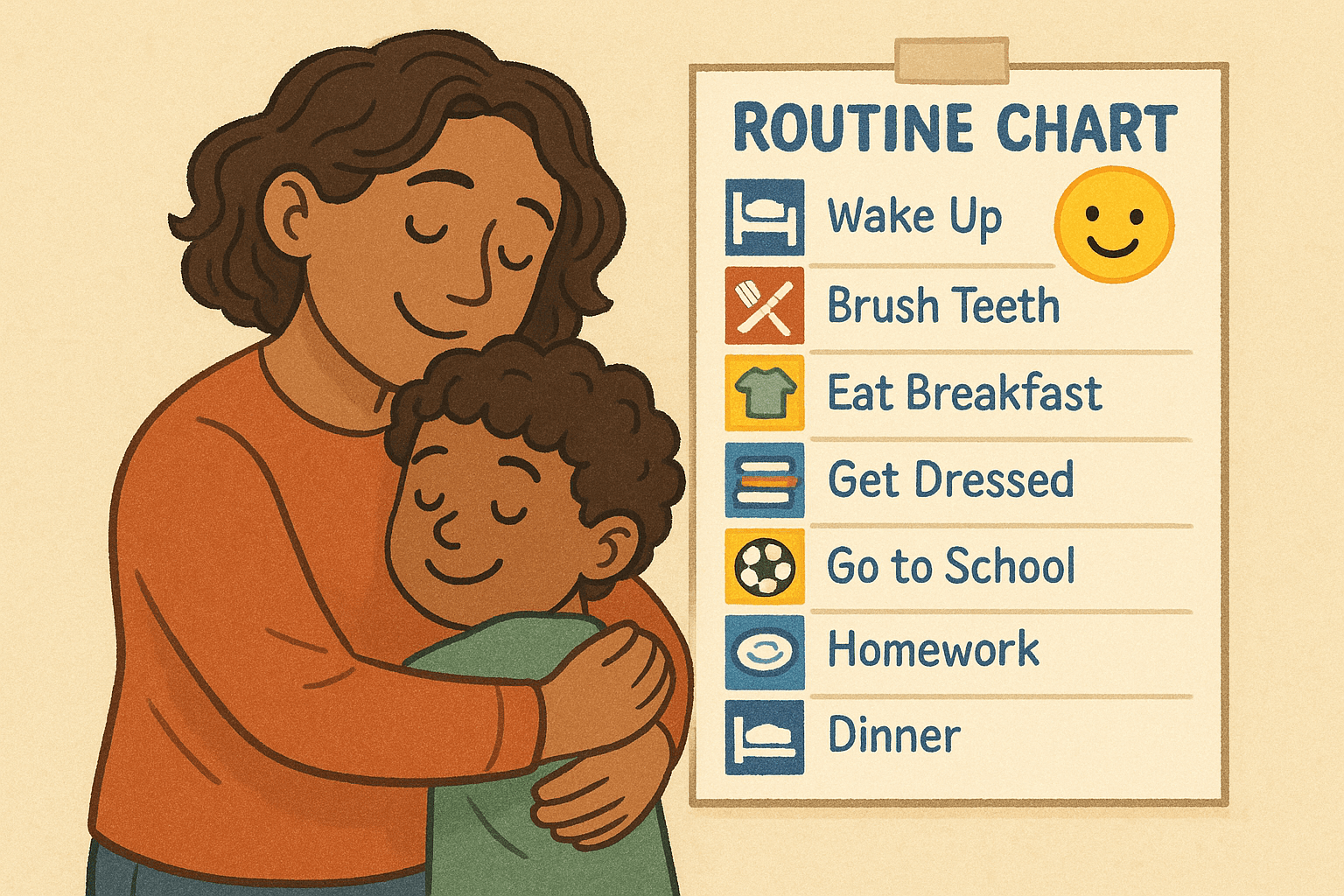
- Incorporate Time & Routines: Use an analog clock. Discuss daily schedules: "Your class is 45 minutes long. If it starts at 10, when will it end?"
- Play Strategic Games: Games like Ludo, Snakes & Ladders, or simple card games require counting, subitizing (recognizing dot patterns on dice), and forward planning.
Building Fluency & Problem-Solving Stamina (Ages 9-12)
This is the stage to move from basic arithmetic to flexible thinking, where the *how* and *why* matter more than the *what*. The focus shifts to reasoning and endurance with multi-step problems.
What to Do:
- Pose Open-ended Questions: "We have ₹300 for our picnic snacks. How should we spend it?" Create a budget list. "How many different ways can you make the number 100 using addition or multiplication?"
- Encourage Multiple Strategies: If they solve 15 x 4, ask, "Can you solve it another way?" (15+15+15+15, or 10x4 + 5x4). Validate all logical methods.
- Link to Interests: Love cricket? Calculate batting averages, run rates, or stadium capacities. Enjoy art? Explore geometric patterns in mandanas or Islamic art. Discuss architecture and symmetry.
- Normalize Struggle: Frame a challenging problem as a puzzle to be cracked together. Say, "This is tricky! Let's read it again and draw a picture to understand." Persistence is a mathematical skill.
The Weekly Math Mix: A Quick Plan for Busy Families
Aim for small, consistent interactions rather than marathon sessions.
- Monday (Measurement Day): Involve them in a cooking task or measuring a room for a new mat.
- Tuesday (Game Night): Play a board game or a round of mental math cards.
- Wednesday (Puzzle Day): Try a age-appropriate logic puzzle or Sudoku together.
- Thursday (Story Math): Read a story that involves a problem to solve (like a folk tale involving sharing).
- Friday (Shopping Preview): Plan the weekend shopping list with a rough budget.
- Weekend (Project & Explore): A slightly longer activity—plan a route on a map, design a floor plan for dollhouse, analyze a mobile data plan.
What to Avoid: Common Well-Intentioned Missteps
1. Prioritizing Speed Over Understanding: Celebrating only the fastest answer can create anxiety and superficial learning. Depth is key.
2. Saying "I Was Bad at Math Too": This implicitly gives permission to give up and frames math as an innate talent rather than a learnable skill.
3. Over-relying on Drills & Tuition: Drills have a place for basic fact fluency, but without conceptual grounding, they lead to fragile knowledge. Tuition should complement, not replace, real-world understanding.
4. Correcting Every Single Mistake Immediately: Instead, ask guiding questions: "Can you walk me through how you got that answer?" The error pattern is more informative than the wrong answer.
5. Treating Math as a Separate, Siloed Subject: The most powerful learning happens when math is seamlessly integrated into science, art, sports, and daily planning.
When to Seek Additional Support
It's normal for children to progress at different paces and find some concepts challenging. However, if you observe persistent and significant signs like:
- Intense anxiety or physical distress (crying, stomach aches) specifically around math tasks.
- A major gap between verbal reasoning and numerical understanding.
- Consistent difficulty with very foundational concepts like number magnitude (understanding that 7 is more than 5) beyond age 7-8.
Consider a compassionate conversation with their teacher. A good educator can provide insight and strategies. In some cases, a structured assessment by an educational psychologist or a specialized tutor can identify specific learning needs (like dyscalculia) and provide targeted, evidence-based interventions. Early, supportive action is always more effective than later remediation.
Frequently Asked Questions
Q: My child hates math and says it's boring. How can I change this?
A: Start by decoupling math from textbooks and worksheets. Find the math in what they *already* love. Does they love building? Introduce architecture and geometry. Are they a natural organizer? Let them plan a party budget or a travel itinerary. Use games, puzzles, and physical activities. Your attitude is contagious—show curiosity and wonder when you encounter math in the wild.
Q: Is using fingers to count a bad habit? Should I stop them?
A: Absolutely not. Fingers are our built-in, visual-tactile manipulatives. Research shows finger use supports the development of number representation in the brain. Children will naturally stop using them as mental strategies become more efficient. Discouraging it can remove a crucial cognitive support.
Q: How do I balance schoolwork (which is often about memorization) with this conceptual approach?
A: Think of schoolwork as the "what" and your home approach as the "why" and "how." Help them see the connections. When memorizing tables, also explore patterns *within* the tables (e.g., in the 9s table, the digits add to 9). When doing a word problem from school, recreate it with real objects. You are providing the context that makes the schoolwork meaningful, which ultimately leads to better retention and less stress.
Your Next Step: The Mathematician's Mindset
The most powerful tool you have is your own language and mindset. Start today by simply noticing and narrating the math around you. "Wow, the parking lot has rows and columns of cars—just like an array!" or "Let's estimate how many litres of water that tank might hold."
Your calm confidence that math is accessible, interesting, and all around us will be your child's greatest anchor. Share a math moment you discovered together this week with another parent. By changing the conversation from "scores" to "thinking," we can collectively build a generation of confident, creative problem-solvers, ready for the world's challenges. The journey begins with a single, curious question.